In the complex world of modern retail, every decision around inventory can significantly impact your bottom line. You are likely evaluating solutions to the persistent challenge of having too much stock in one location and not enough in another, a dilemma that stifles growth and erodes profitability. This guide will provide the authoritative insights you need to understand how advanced AI can transform your inventory strategy, offering a clear path to optimizing stock movement, reducing waste, and boosting sales across your entire network.
The trillion dollar problem of inventory distortion in retail
The global retail landscape grapples with a monumental challenge: inventory distortion. This encompasses both the costly problem of overstock and the equally damaging issue of stockouts. In 2023 alone, global retailers faced an estimated $1.77 trillion in losses due to inventory distortion, a figure representing approximately 7.2% of total retail sales. Broken down, out-of-stock incidents cost retailers between $690.9 billion and $1.2 trillion, while overstock losses amounted to $562 billion.
Why does this problem persist despite sophisticated planning tools? Traditional inventory management often fails in dynamic retail environments because it relies on static forecasts and manual processes that cannot keep pace with real-time shifts in consumer demand, local trends, or unexpected disruptions. Many of these issues are internal, with an astounding 72% of stockouts stemming from poor planning and process inefficiencies, rather than external supply chain disruptions. This highlights a critical need for a more agile and intelligent approach to inventory. Learn more about how AI can solve inventory distortion through dynamic stock balancing.
Understanding AI-driven inventory redistribution
AI-driven inventory redistribution is the dynamic process of automatically identifying and correcting inventory imbalances across your entire retail network to precisely meet localized demand. It moves beyond generic inventory optimization by actively recommending and even executing the strategic transfer of stock between stores, warehouses, or distribution centers. This ensures that every item is in the right place at the right time, minimizing lost sales and preventing excess inventory.
The core capabilities of AI-driven redistribution include sophisticated demand sensing, highly accurate predictive analytics, automated replenishment triggers, rapid anomaly detection, and advanced scenario analysis. By leveraging these, AI transforms reactive inventory management into a proactive, strategic advantage. Unlike traditional systems that might simply flag an imbalance, agentic AI solutions learn, adapt, and propose optimal stock movements that human planners might miss. AI-driven inventory imbalance redistribution can act as an intelligent co-pilot for your inventory operations.
The core pillars of how agentic AI tackles key inventory challenges
Agentic AI, by design, provides business-specific contextual accuracy and validation, ensuring that inventory decisions are not just data-driven but also aligned with your strategic objectives. This precision allows it to address critical challenges faced by retailers.
Eliminating stockouts and lost sales
Stockouts represent lost sales opportunities and customer dissatisfaction. Agentic AI addresses this by providing unparalleled foresight into demand.
- Real-time demand sensing:
Continuously monitors sales data, local events, weather patterns, and even social media trends to predict demand fluctuations at a granular level.
Offers precise demand predictions down to the SKU, location, and even size level, enabling optimal initial distribution.
- Proactive identification:
Automatically flags potential stockout risks before they occur, allowing for timely intervention and stock transfers.
Preventing overstock and capital lockup
Excess inventory ties up valuable capital, incurs holding costs, and risks obsolescence. Agentic AI mitigates this by optimizing stock levels across your network.
Adjusts order thresholds based on predicted demand and lead times, preventing the accumulation of unwanted stock.
- Multi-location optimization:
Recommends the optimal allocation and movement of inventory across all your stores and warehouses, ensuring efficient use of stock.
- Automated inter-store transfer recommendations:
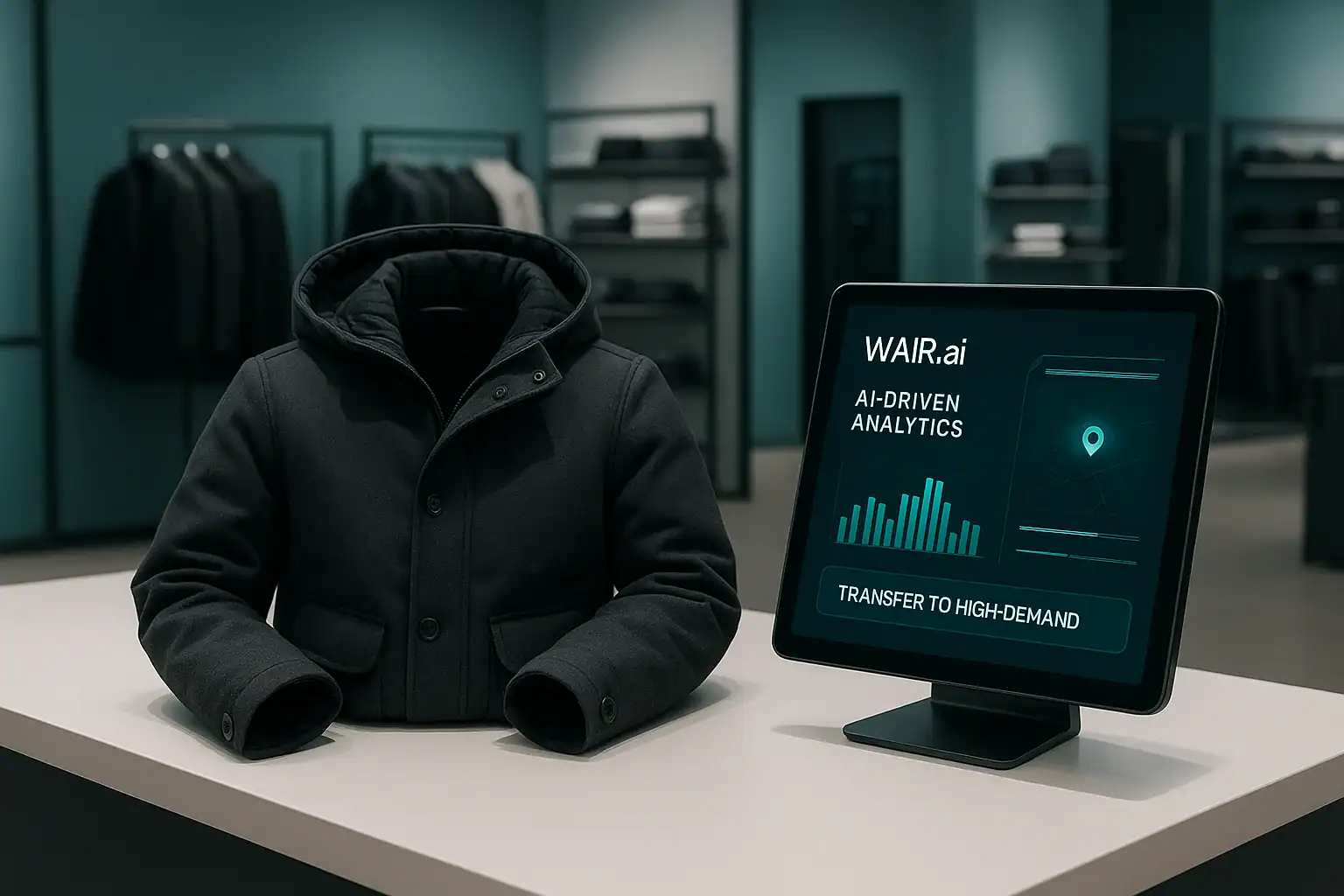
Identifies opportunities to move slow-moving items from one store to a high-demand store, dramatically improving sell-through rates. For a deeper dive into balancing stock across your retail locations discover how AI-driven stock balancing in retail helps you balance your stock.
Reducing Dead or Slow-Moving Inventory
Dead stock is a drain on resources and a common source of margin erosion. Agentic AI can detect these issues early and propose solutions.
- Early SKU identification:
Predicts which items are likely to become slow sellers, long before they become a problem.
- Proactive redistribution strategies:
Recommends moving at-risk inventory to locations where demand is higher, or even suggesting bundling or strategic liquidation options.
- AI-powered ABC/XYZ classification:
Dynamically categorizes inventory based on value, sales volume, and demand variability, enabling targeted redistribution strategies. You can explore how AI-driven inventory redistribution tackles imbalances by visiting our dedicated page.
Proactive markdown management
Markdowns are often a necessary evil, but AI can turn them into a strategic advantage by optimizing timing and depth.
Utilizes sophisticated algorithms to recommend the optimal timing, depth, and segmentation for markdowns, maximizing sell-through while protecting margins.
- Simulation and continuous learning:
Simulates various markdown scenarios to predict outcomes and continuously learns from past performance to refine future strategies.
- Reducing end-of-season markdowns:
By proactively redistributing inventory to high-demand locations, AI significantly reduces the volume of stock that requires deep discounts at season’s end. Resulting in that agentic AI enhances inventory visibility for proactive markdown management.
Quantifiable ROI and strategic advantages
The adoption of agentic AI solutions is not just a technological upgrade, it’s a strategic imperative that delivers significant, measurable returns. Retailers that embrace AI see substantial improvements across their operations. Within five years of adopting AI solutions, retailers report a notable 39% increase in profits and a 31% revenue growth. Overall, AI has the power to improve supply chain efficiency by up to 40%. McKinsey estimates further reinforce this, suggesting AI can reduce inventory levels by 20–30% and logistics costs by 5–20% for distributors.
Financial benefits
AI-enabled Multi-Echelon Inventory Optimization (MEIO) can reduce overall inventory costs by 15–30%.
By minimizing stockouts and optimizing availability, AI can increase service levels by 5–10 percentage points, directly translating to higher sales.
Optimizing stock flow and proactively managing markdowns directly impacts your gross margin, turning potential losses into profit.
Operational efficiency
AI automates complex calculations and data analysis, freeing up your planning teams to focus on strategic initiatives rather than manual tasks.
AI provides immediate, actionable insights into inventory health across your entire network, enabling swift responses to changing conditions. You can see these insights firsthand with AI-powered inventory dashboards and reports.
- Improved decision making:
Data-driven recommendations remove guesswork, leading to more confident and accurate inventory decisions, all while monitoring key inventory performance indicators for strategic retail management.
Sustainability impacts
Minimizing excess stock through intelligent redistribution directly contributes to environmental sustainability goals by reducing unsold goods that might otherwise be discarded.
More efficient logistics and fewer unnecessary transfers or returns mean a reduced carbon footprint throughout your supply chain.
Implementation roadmap, navigating your AI journey in retail
Embarking on an AI journey might seem daunting, but with a structured approach, retailers can effectively integrate AI for inventory redistribution and stock balancing.
Phase 1: Assessment and Data Readiness
The foundation of any successful AI implementation is robust data. Begin by thoroughly assessing your current inventory processes and identifying specific pain points.
Pinpoint where stockouts, overstocks, and inefficient transfers are most prevalent.
- Importance of data quality:
Understand that AI thrives on clean, comprehensive data. Develop strategies for integrating diverse data sources from ERPs, POS systems, and even external factors like weather. Establishing a solid retail AI data foundation is crucial for success.
Phase 2: Solution selection and integration
Choosing the right AI solution is paramount. Look for platforms designed to integrate seamlessly into your existing technological ecosystem.
- Key features to look for:
Prioritize solutions offering granular forecasting, automated recommendations for transfers, and seamless integration capabilities.
- Addressing legacy systems:
Select solutions that can work effectively with your existing ERP or WMS, avoiding costly and disruptive overhauls. Explore how to integrate AI into your retail tech stack for a smooth transition.
Phase 3: Pilot, scale, and culture Change
Successful AI adoption involves both technology and people. Start small to demonstrate value, then scale thoughtfully.
Pilot the AI solution with a specific product category, store cluster, or region to gather early learnings and demonstrate tangible results.
Continuously track key performance indicators to quantify the value delivered by the AI solution and build internal confidence.
Provide comprehensive training for your inventory teams, emphasizing how AI augments their expertise rather than replaces it, enabling a positive retail AI adoption and people strategy.
Multi-Echelon Inventory optimization with agentic AI
For retail networks with complex supply chains spanning multiple warehouses, distribution centers, and stores, Multi-Echelon Inventory Optimization (MEIO) becomes critical. MEIO simultaneously optimizes inventory levels across all echelons, considering the intricate relationships and costs at each stage.
Agentic AI takes MEIO to the next level by deploying advanced models like deep learning and reinforcement learning. These sophisticated algorithms not only provide predictive analytics to foresee demand but also offer prescriptive analytics, recommending optimal actions to achieve desired outcomes. Agentic AI can understand the complex interplay of inventory, demand, and logistics costs, making validated, autonomous decisions that go beyond what traditional MEIO systems can achieve. This ensures maximum efficiency and profitability across your entire supply chain. Discover the power of predictive and prescriptive analytics in retail.
Future-proofing your retail inventory with intelligent redistribution
The future of retail inventory management is undeniably AI-driven. By embracing agentic AI for inventory redistribution and stock balancing, you are not just solving today’s inventory problems, you are building a resilient, agile, and profitable retail operation ready for tomorrow’s challenges. The competitive advantage lies with those who harness the power of intelligent automation to eliminate waste, maximize sales, and consistently delight customers.
Don’t let inventory distortion continue to erode your profits. Explore how agentic AI can transform your inventory strategy by scheduling a meeting with our experts or delving deeper into our AI pricing solutions to see how tailored AI can work for your business.
Frequently asked questions
Q: Is AI too complex for my retail business to implement?
A: Modern agentic AI solutions are designed for ease of use, abstracting complex data science so your teams can focus on strategic outcomes and business impact, rather than technical complexities.
Q: Does AI replace human inventory planners?
A: No, AI augments human expertise, automating routine tasks and providing data-driven insights so planners can make more strategic, high-value decisions, focusing on exceptions and long-term strategy.
Q: How quickly can retailers expect to see results from AI redistribution?
A: While implementation timelines vary, many retailers report measurable improvements in inventory turns and reduced markdowns within 3 to 6 months of deploying agentic AI solutions.
Q: What kind of data does AI need for effective redistribution?
A: AI thrives on diverse data, including historical sales, promotional calendars, weather, demographic information, store-specific performance, and product attributes for comprehensive forecasting and balancing.
Q: How can I ensure AI recommendations align with our business rules and strategy?
A: Leading agentic AI platforms allow you to configure business rules and parameters, ensuring that AI-driven recommendations are not only data-optimized but also strategically aligned with your brand’s operational guidelines and compliance requirements.