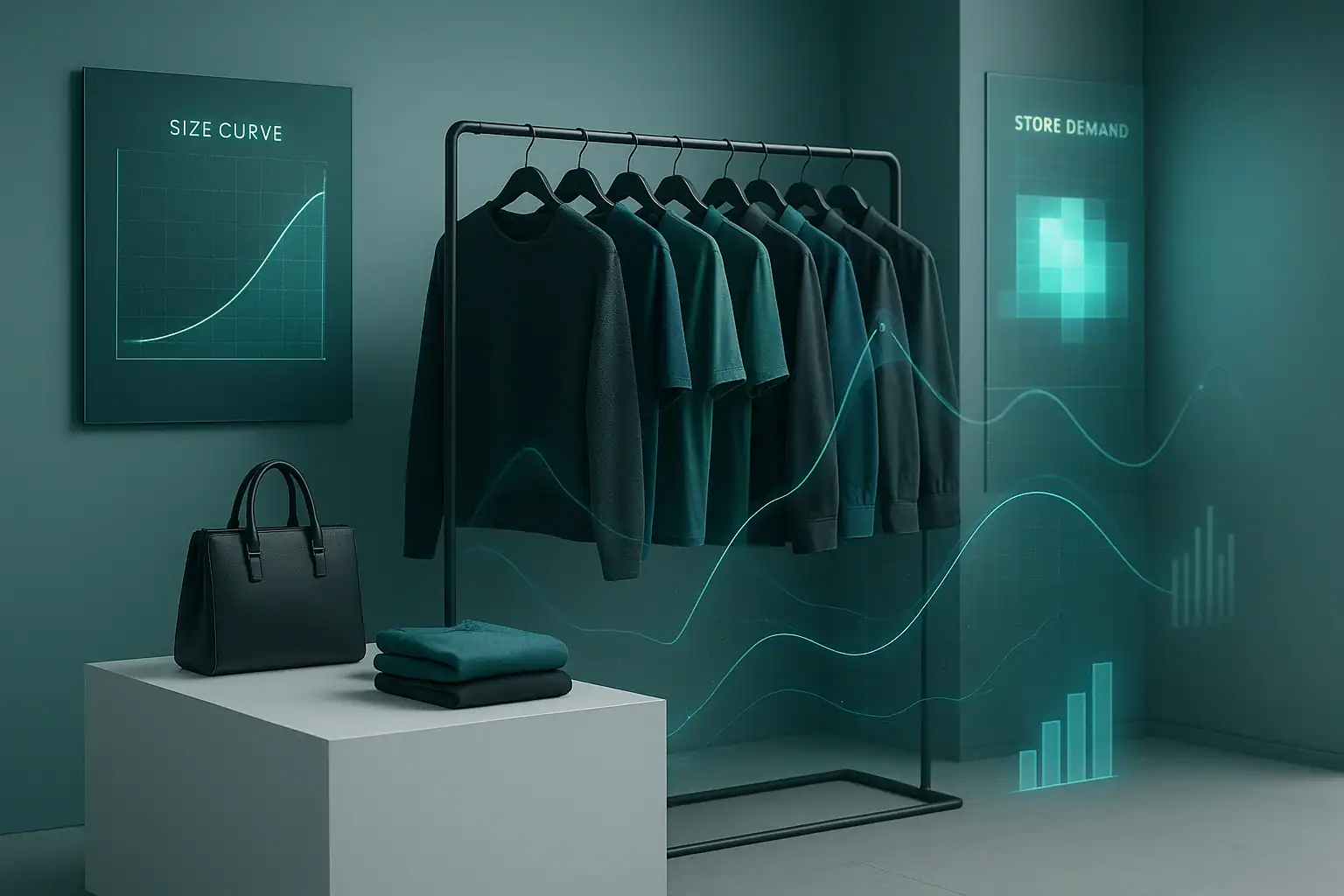
The profit-killing paradox, how precisely optimized size curves drive 10%+ gross margin improvement in fashion retail. Fashion retailers often grapple with a silent profit killer, suboptimal size curve allocation. You might have your bestsellers flying off the shelves, yet simultaneously face a frustrating surplus of unpopular sizes and crippling stockouts in high-demand ones. This scenario, commonly known as broken size runs, directly erodes profitability and customer satisfaction. While traditional methods for managing size allocation have existed for decades, the complexity of modern retail demands a more dynamic, precise, and intelligent approach. Our guide explores how advanced AI solutions are transforming size curve planning, ensuring every garment finds its ideal customer, and significantly boosting your bottom line.
The true cost of suboptimal size allocation
When a customer can’t find their size in a popular item, it’s not just a missed sale,it’s a potential lost customer. Conversely, holding excess inventory in slow-moving sizes ties up capital, occupies valuable floor space, and inevitably leads to markdowns. This paradox is a daily reality for many retailers. Poor size curve accuracy can cause as much as 15-20% of inventory to stagnate on the floor, directly impacting revenue and space utilization. This isn’t merely an operational challenge, it’s a strategic imperative that influences everything from cash flow to brand perception.
Why traditional size planning methods fall short:
Traditional approaches often rely on historical sales data, which, while seemingly logical, presents several critical flaws in accurately predicting future demand by size.
Sales data only tells you what was sold, not what could have been sold. If a popular size was out of stock, its true demand is underestimated, creating a “hidden stockout” that distorts future allocations.
Applying a universal bell curve across all products and stores ignores crucial variations in local demographics, cultural preferences, and product attributes. A size curve for a fitted dress in a bustling urban boutique will differ significantly from a casual tee in a suburban family store.
Past performance doesn’t perfectly predict future trends in a fast-moving fashion landscape. Relying solely on historical data can lead to missed opportunities for new collections or misjudgments for rapidly changing trends.
Attempting to manually adjust size curves for hundreds of SKUs across dozens or hundreds of stores is time-consuming, prone to human error, and virtually impossible to scale effectively.
The anatomy of a perfect size curve, redefining demand accuracy
A size curve, at its core, represents the ideal distribution of sizes for a particular product. A truly optimized size curve ensures that each store receives the precise quantity of every size needed to meet actual customer demand, minimizing both stockouts and overstock. This level of precision moves beyond simple historical averages, embracing a multifaceted understanding of demand signals.
To achieve this, an agentic AI company like WAIR.ai, integrates a vast array of data points far beyond mere sales history. This includes:
- Detailed product attributes:
Understanding fabric type, silhouette, fit (e.g., slim, relaxed), and style.
Age groups, income levels, cultural backgrounds, and regional body types.
Weather patterns, local events, and seasonal shifts.
- Customer behavior analytics:
Purchase patterns, returns data, and browsing habits.
By synthesizing these insights, AI can construct a dynamic and adaptive size profile for every product, unique to each selling location or cluster of stores, significantly improving your overall size curve planning and sell-through efficiency.
How advanced algorithms deliver unprecedented precision
The true power of AI in size curve optimization lies in its ability to process complex, multi-dimensional data with unmatched speed and accuracy. It’s not just about crunching numbers, it’s about discerning hidden patterns and making intelligent, proactive decisions.
Understanding the algorithmic edge:
How a sophisticated AI algorithms tackles challenges that traditional methods cannot overcome:
- Dealing with data sparsity and cold starts:
For new products or locations with limited historical data, AI leverages “like-for-like” product mapping and attribute embeddings. It identifies similar products, categories, or store types to intelligently infer demand patterns, ensuring even novel items receive optimal initial allocations.
- Correcting sales data bias:
Agentic AI models are designed to “see” hidden demand. By analyzing stock levels alongside sales, they can differentiate between a lack of demand and a stockout that prevented a sale. This allows the AI to accurately estimate true demand, even when inventory limitations have historically distorted sales figures.
- Handling high dimensionality and volatility:
Fashion demand is influenced by many factors that change rapidly. Advanced optimization techniques, including neural networks and scenario-based optimization, enable AI to parameterize algorithms and adapt to these volatile market conditions, ensuring that predictions remain robust amidst fluctuations.
- Intelligent store clustering:
Rather than arbitrary groupings, AI employs advanced clustering algorithms for store and channel analysis, like K-Means or hierarchical clustering, to identify stores with genuinely similar demand patterns. This ensures that a store in a beach town isn’t allocated the same size curve for winter coats as a store in a mountain resort, even if their overall sales volumes are similar.
This technical depth allows AI to move beyond reactive analysis, providing the foundational intelligence for AI-driven inventory analytics in fashion.
Adapting the curve, hyper-local allocation for diverse store profiles
One of the most significant advantages of AI-driven size curve optimization is its capacity for granular adaptation. It understands that a one-size-fits-all approach is a recipe for inefficiency. Instead, it tailors the size distribution to the unique characteristics of each store or even specific micro-markets. This level of customization is impractical without advanced AI-powered inventory allocation.
Granular adaptability in action:
Consider these scenarios and how AI intelligently adjusts size curves:
- Urban flagship versus suburban big box:
For a premium denim brand, an urban flagship store in a fashion-forward city might receive a higher proportion of smaller, trend-driven sizes, while a suburban big box store catering to families might require a broader distribution weighted towards common and larger sizes.
- Seasonal resort versus year-round local store:
A store in a ski resort will naturally have a different size demand for technical outerwear compared to a year-round boutique in a warmer climate. AI dynamically adjusts these curves based on anticipated seasonal demand, local weather patterns, and even specific event schedules.
- Product specific adjustments:
A form-fitting dress requires a different size curve distribution than a loose-fitting tunic, even within the same store. AI understands these nuances, adjusting allocations based on the garment’s design and intended fit.
- Regional demographic variations:
As research shows, even within the same country, regional preferences and average body types can vary significantly. AI identifies these subtle differences, ensuring that a store in, for example, the Southwest US receives a size distribution that reflects its local customer base more accurately than a store in the Northeast.
This dynamic adaptation is powered by agentic AI, which not only predicts but also proactively executes these nuanced allocations. It continuously monitors live sell-through data, adjusting future replenishments to prevent broken size runs before they impact sales, transforming insights into autonomous action. Understanding how AI agents operate in fashion retail can reveal the depth of this proactive intelligence.
Quantifying the ROI of size curve optimization
The strategic implementation of AI-driven size curve optimization doesn’t just improve operational efficiency, it delivers tangible, measurable financial returns that directly impact your gross margin. Retailers seeking to calculate their retail AI ROI will find significant benefits.
Key financial impacts:
- Gross margin improvement:
By ensuring optimal size availability, you reduce the need for aggressive markdowns on slow-moving sizes and maximize full-price sell-through. AI-driven demand forecasting can lead to a 41% increase in revenues, and strategic size allocation has been shown to increase sales by 3-4% in major fashion brands, significantly boosting gross margins by 5-10%.
- Inventory cost reduction:
Minimizing overstocks by preventing 15-20% of inventory from stagnating on shelves translates directly into lower carrying costs, reduced warehousing expenses, and less capital tied up in unproductive stock. Simultaneously, preventing stockouts in popular sizes eliminates lost sales opportunities, contributing to healthier inventory turnover rates, which ideally range between 5-8 times per year for fashion retail.
Optimized initial allocations and intelligent replenishment strategies lead to a 2.9% reduction in distribution center replenishment and picking costs. Fewer transshipments between stores to balance inventory, and a streamlined supply chain, free up valuable labor and resources, allowing teams to focus on more strategic initiatives.
- Enhanced customer satisfaction and loyalty:
When customers consistently find their size, it builds trust and encourages repeat purchases, fostering stronger brand loyalty and reducing the likelihood of them seeking alternatives.
The cumulative effect of these improvements provides a compelling case for investing in advanced AI solutions for inventory management.
Implementing success, using best practices for AI-driven size allocation
Transitioning to an AI-driven size allocation system involves more than just implementing new software, it requires a strategic approach to data, processes, and people. A successful AI retail implementation plan ensures smooth adoption.
Critical success factors:
- Data collection and quality:
The foundation of any effective AI system is high-quality, comprehensive data. Ensure your existing data (sales, inventory, returns, product attributes) is clean, consistent, and accessible. Supplement this with external data sources like demographics and weather.
- Collaboration across teams:
Successful adoption requires merchandising, planning, and operations teams to work together, understanding how AI augments their expertise. AI is a tool that empowers, not replaces, human intuition and experience.
- Seamless technology integration:
The AI solution should integrate smoothly with your existing ERP, POS, and inventory management systems. This ensures data flows freely and decisions can be executed without manual intervention.
- Change management and training:
Overcoming reliance on “gut feel” requires clear communication, training, and demonstrating the tangible benefits of AI. Foster an environment where your teams see AI as a partner that frees them for more strategic, creative work.
- Continuous monitoring and refinement:
AI models are not set-it-and-forget-it solutions. Regularly monitor performance, provide feedback, and allow the system to learn and refine its predictions based on new data and changing market dynamics. This iterative process ensures ongoing optimization.
Transform your bottom line with precision sizing
The fashion industry is rapidly evolving, with trends toward hyper-personalization, virtual try-ons, and seamless omnichannel experiences. At the heart of these innovations is the precise understanding of customer preferences, especially when it comes to fit and sizing. By investing in an agentic AI solution like WAIR.ai, you are not just optimizing your current inventory challenges, you are future-proofing your business. You are enabling a proactive inventory strategy that prevents lost sales, reduces waste, and directly contributes to a healthier, more profitable retail operation.
The opportunity to leverage advanced AI to transform your size curve allocation is here. It’s an investment that promises not only immediate improvements in gross margin and inventory efficiency but also positions your brand at the forefront of sustainable and responsive retail. To explore how you can leverage these advanced solutions, consider scheduling a meeting with our experts.
Frequently asked questions
Q: What is a size curve in retail, and why is it important for profitability?
A: A size curve represents the percentage distribution of different sizes for a specific product. Optimizing it ensures stores receive the right mix of sizes to match customer demand, preventing lost sales from stockouts and reducing markdowns from overstock, directly impacting profitability.
Q: How does AI improve upon traditional size allocation methods?
A: AI uses advanced algorithms to analyze vast datasets, including historical sales, demographics, and product attributes, to predict demand more accurately. It overcomes biases in historical data, dynamically adapts to unique store profiles, and can proactively adjust allocations, something traditional, static methods cannot achieve.
Q: Can AI-driven size curve optimization help reduce inventory waste?
A: Yes, significantly. By precisely matching inventory to demand at the size level, AI minimizes overstock in unpopular sizes, reducing the need for markdowns and decreasing overall inventory holding costs and waste. This supports a more sustainable retail model.
Q: How quickly can retailers expect to see a return on investment (ROI) from implementing AI for size curve optimization?
A: While specific timelines vary, retailers typically see measurable improvements in key metrics like sell-through rates, gross margins (often 5-10% improvement), and inventory turnover within the first few months. The operational efficiencies, such as reduced transshipments and labor costs, also contribute to a rapid ROI.
Q: Is AI for size curve optimization complex to integrate into existing retail systems?
A: A well-designed agentic AI solution, like those offered by WAIR.ai, is built for seamless integration with existing ERP, POS, and inventory management systems. The goal is to augment your current infrastructure, not replace it, ensuring a smooth transition and minimal disruption to operations.